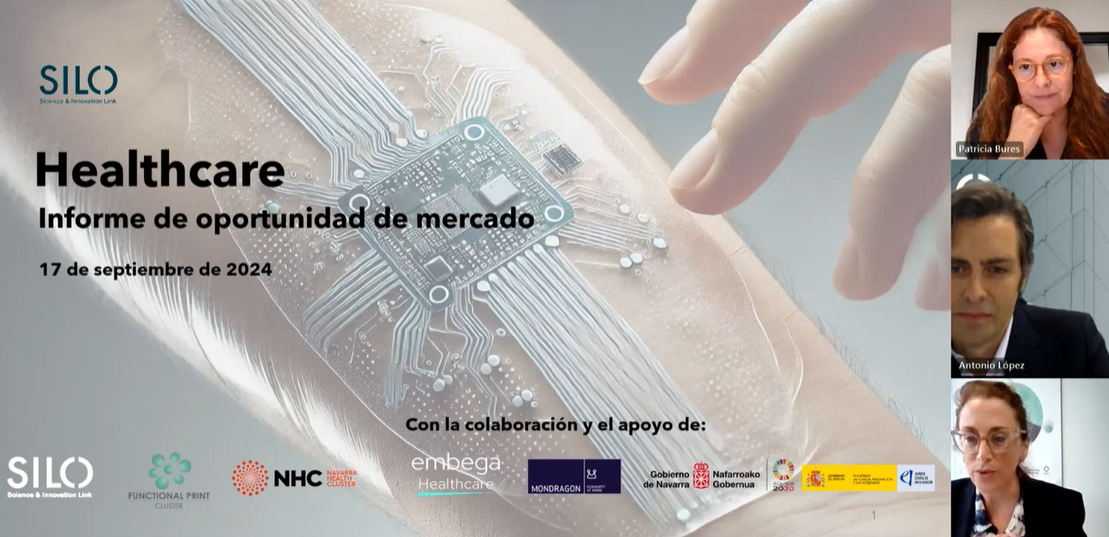
What is the impact of a technology as promising as functional printing on the healthcare sector and how will it change the way medical care is delivered? This was the theme of the “Printing4healthcare” meeting organized by Navarra Health Cluster and the Navarre cluster Functional Print to explore the most recent advances in functional printing in medicine and in the patient, and the specific opportunities it opens up in the path of innovation for companies specializing in biohealth.
Functional printing, together with 3D printing, has revolutionized the way we design and manufacture products, and the first results are already tangible in the healthcare sector. Thanks to functional printing, it has been possible to develop and integrate printed sensors for eHealth, and 3D printing is making it possible to create customized prostheses and high-precision artificial organs that are personalized for each patient. A situation that suggests a very significant commercial potential for functional printing, as confirmed by the results of the report on trends and opportunities for printed electronics in the healthcare sector presented by SILO, a consulting firm, at the session.
Numerous potential applications of functional printing in the healthcare sector
Printed or flexible electronics consists of electronic circuits and applications produced in whole or in part by printing processes. This technology has many advantages, such as a simple and fast manufacturing process, a high degree of customization, high functionality, although it requires a higher investment at the beginning.
Scientific interest in printed electronics has increased over the past 20 years, and because flexible electronics can withstand mechanical stresses, it is ideal for portable implantable medical devices. It has accompanied the development of home-based patient monitoring by enabling the capture and measurement of health data through biosensors and electrodes, such as glucose testing and heart rate monitoring, which are already well established in the market.
Applications in the health and wellness sector account for around 20% of the total printed electronics market, one of the main fields of application. Among the most promising areas are also cholesterol monitoring, vital sign tracking, wound healing monitoring, implant development, cancer diagnosis, or drug delivery through the skin.
Because it has so many application possibilities, the report concludes that printed electronics will be a key component in many medical devices and a market in excess of $8 trillion is forecast by 2030.
Embega Healthcare also participated in this meeting to show its advances in printed and flexible electronics for the sector.
Ysium Medical, partner of NHC, presented the progress of two projects developed and designed thanks to 3D printing. The first one, Bim3d, is a surgical simulator aimed at students of Medicine, Nursing or Veterinary to practice sutures and incisions on a tissue similar to the skin. After a year and a half of development, and with the support of the Government of Navarre, it is in its final phase of industrialization, and already has a version 2.0, whose main novelty is the use of augmented reality to add more realism to the experience. The second is Nebola, a device for those suffering from throat cancer that allows entering the respiratory system through the throat and connecting it again with the mouth, safely and through the tracheostoma.
Viscofan showed its capabilities and success stories in functional printing with collagen for biomedical research.
This session highlighted that the potential of printed electronics in healthcare in the long term is high, with other applications of interest still in the early stages, and that it could become an essential tool, not only for patient monitoring, but for the sustainability of the healthcare system itself.