Antibiotic resistance is one of the greatest challenges facing global health, as more and more bacteria are able to survive standard treatments. To tackle this problem, Telum Therapeutics, a member of Navarra Health Cluster, is researching an alternative: enzybiotics, proteins that break down the bacterial cell wall until the bacteria are destroyed.
This line of research has an unusual origin. The proteins come from bacteriophages, viruses that only infect bacteria. Using bioengineering, the team can combine their different parts like Lego bricks to design new proteins that are more effective and more stable.
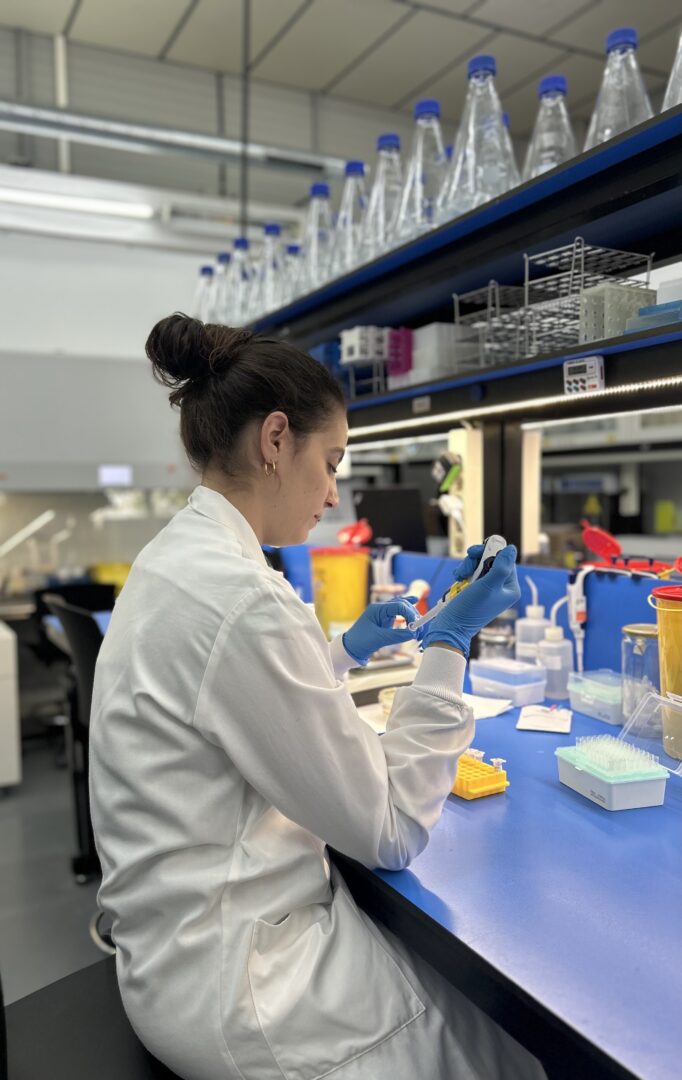
We spoke to Carmen Monreal, who is devoting her PhD to this project. Her research focuses on two bacteria commonly found in lung infections in patients with cystic fibrosis: Staphylococcus aureus and Pseudomonas aeruginosa. After almost three years of work, Carmen tells us how the team went from searching through thousands of genetic sequences to having a promising candidate against S. aureus, what challenges remain and why finding an active protein “is only the beginning”.
What exactly is an enzybiotic, and how does it work against bacteria?
An enzybiotic (from “enzyme” and “antibiotic”) is a protein with antimicrobial activity. In our case, we work with proteins derived from bacteriophages, which are viruses that infect bacteria. These proteins target peptidoglycan, one of the main components of the bacterial cell wall. When this structure is broken down, the bacterium loses its integrity and the cell eventually undergoes lysis.
Why were Pseudomonas aeruginosa and Staphylococcus aureus chosen as the initial focus of the research?
We focused on them because of their importance in lung infections in patients with cystic fibrosis. Staphylococcus aureus is one of the most frequently found microorganisms, while Pseudomonas aeruginosa is associated with more severe infections and poorer disease outcomes. In some cases, co-infections can also occur, which makes treatment more difficult. That’s why we thought it made sense to develop a strategy that could work against both from the outset.
What role does bioengineering play in your work, and what does designing an antimicrobial protein involve?
Bioengineering means we don’t have to limit ourselves to the proteins we find in nature: we can try to improve them. Phage proteins have a modular structure made up of domains. Each domain can have a different function, such as recognising the bacterial cell wall or breaking it down. The idea is to combine these domains, like Lego bricks, to design new chimeric proteins. In doing so, we aim to improve their activity, their stability or their spectrum of action.
Your project began with a search for antimicrobial proteins in viral metagenomes. How do you go from that vast initial diversity to identifying something with real potential?
Because we start from environmental samples, there’s a huge diversity of viral genetic material. We use bioinformatics tools to search for sequences that could correspond to phage proteins. We then predict their structure and select the ones whose features make them look most promising. From there, we move from the computer to the lab, where we test them experimentally.
How has the project evolved since you started your PhD?
The project started out with quite a broad scope: discovering new enzybiotics, designing chimeric proteins and evaluating their activity. Over these years, we’ve moved from the initial discovery phase to a stage that is much more focused on characterising and optimising the proteins we’ve identified. We’re now working on optimising expression and purification conditions and, above all, on thoroughly characterising the antimicrobial activity of the most promising candidates against a range of bacterial strains.
Part of your research also looks at biofilms. Why are they so difficult to treat?
Because bacteria in a biofilm don’t behave in the same way as when they’re free-floating. In a biofilm, they organise themselves into a community and become surrounded by a matrix that protects them and makes it harder for antimicrobials to reach them. They also undergo physiological changes that can make them less susceptible to certain treatments. That’s why a protein that works well against bacteria in suspension may not be as effective against a biofilm, and it’s important to evaluate both scenarios.
Have there been any unexpectedly positive results? Which result are you especially proud of?
Uno de los resultados que más ilusión me ha hecho ha sido encontrar un candidato que está mostrando una actividad muy prometedora frente a S. aureus. A partir de ahí, hemos ido centrando el trabajo en caracterizarlo mejor y en optimizar las condiciones de producción y purificación. También es de lo que estoy más orgullosa, porque hemos pasado de identificar proteínas que podrían ser interesantes a tener un candidato concreto sobre el que podemos profundizar y plantearnos los siguientes pasos.
What challenges remain, and what would be the next steps for this line of research?
Right now, one of the main challenges is to finish optimising the candidate’s production and purification and to characterise it as fully as possible, in terms of both activity and stability. We also want to better understand how it works against different strains of S. aureus and under conditions that come increasingly close to a potential real-world application.
After that, one of the most important steps will be to take the candidate into the planned in vivo studies. That’s where we’ll be able to see whether the behaviour we’re observing in vitro holds up in a more complex model.
Después de casi tres años trabajando en el proyecto, ¿qué has aprendido sobre lo complejo que es transformar un descubrimiento inicial en algo que pueda avanzar hacia una potencial aplicación terapéutica?
Above all, that finding an active protein is only the beginning. It might seem that once you’ve found a protein with good activity, you’ve done most of the work, but then you realise there are lots of issues you still have to work through: how to produce it, whether it’s stable, or whether it keeps its activity when conditions change.
Ultimately, there’s still a long way to go between finding something promising and it actually having a real-world application.
The Government of Navarra funded the recruitment of the PhD student under the 2023 Industrial Doctorates (Doctorados Industriales 2023) funding call. Grant reference: 0011-1408-2023-000007